
AI models change every month. This doesn't.
AI models change every month. This doesn't.
You feel overwhelmed by AI and it's changing every month. Nobody's telling you what to actually learn first. Here's the map of what's underneath every AI tool you use that will never change, and why it's an important part of AI literacy.

" height="20px" id="D2av7Oa6w" width="20px"/></svg>)
" height="20.035778175313055px" id="eWFuVHpu9" width="22.150617531305898px"/></svg>)
" height="20.19299259259259px" id="jW1ICukqX" transform="translate(0 0)" width="20.05540740740753px"/><path d="M 5.014 19.008 C 7.783 19.008 10.028 14.753 10.028 9.504 C 10.028 4.256 7.783 0 5.014 0 C 2.245 0 0 4.256 0 9.504 C 0 14.752 2.245 19.008 5.014 19.008 Z" fill="rgb(0, 0, 0)" height="19.00823703703702px" id="o80dVBhnW" transform="translate(21.028 0.592)" width="10.02800000000002px"/><path d="M 1.764 17.031 C 2.738 17.031 3.527 13.218 3.527 8.515 C 3.527 3.813 2.739 0 1.764 0 C 0.79 0 0 3.814 0 8.515 C 0 13.217 0.79 17.031 1.764 17.031 Z" fill="rgb(0, 0, 0)" height="17.030755555555572px" id="dzJnzwG1A" transform="translate(32.028 1.58)" width="3.527407407407395px"/></g></svg>)

Being a technical PM has always meant being literate in traditional software like APIs, data, etc. You don't need to know how to build or code, but you do need to hold your own in discussions about technical trade-offs, understand how technical constraints shape product decisions, evaluate feasibility, and scope timelines.
In 2026, all of that is now table stakes. You still collaborate with engineers on features and products, but now it spans both traditional software and AI.
Plus you're also now a builder. Maybe you’re prototyping with AI. Maybe creating agents. Maybe you’re setting up whole agentic workflows.
In other words, the technical part of your job didn't change. It doubled.
But if jumping straight into trying to master all of it - prompting techniques, the evaluation workflows, creating AI agents and agentic workflows - is the wrong way to go about it.
The way to keep up isn't chasing the thing that keeps changing, but to first understand the technology underneath it that doesn’t change.
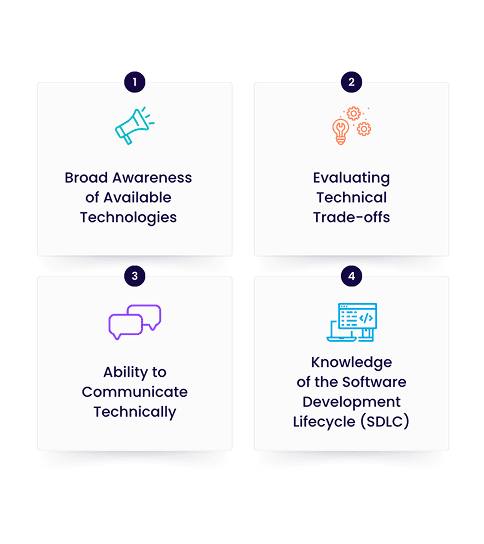
The 4 Technical Skills Every PM Should Know
Learn what “being technical” means for PMs—and the 4 core skills that build true technical fluency.
So what doesn’t change?
Every AI tool you’ll use as a PM is powered by a large language model (LLM). Claude Cowork, ChatGPT Codex, Lovable, etc. are all powered by LLMs and their core capabilities and limitations are the same.
Which means the highest-leverage thing you can understand isn't any individual tool. It’s understanding the LLM itself.
Here's the map of the core mechanics of LLMs you need to understand:
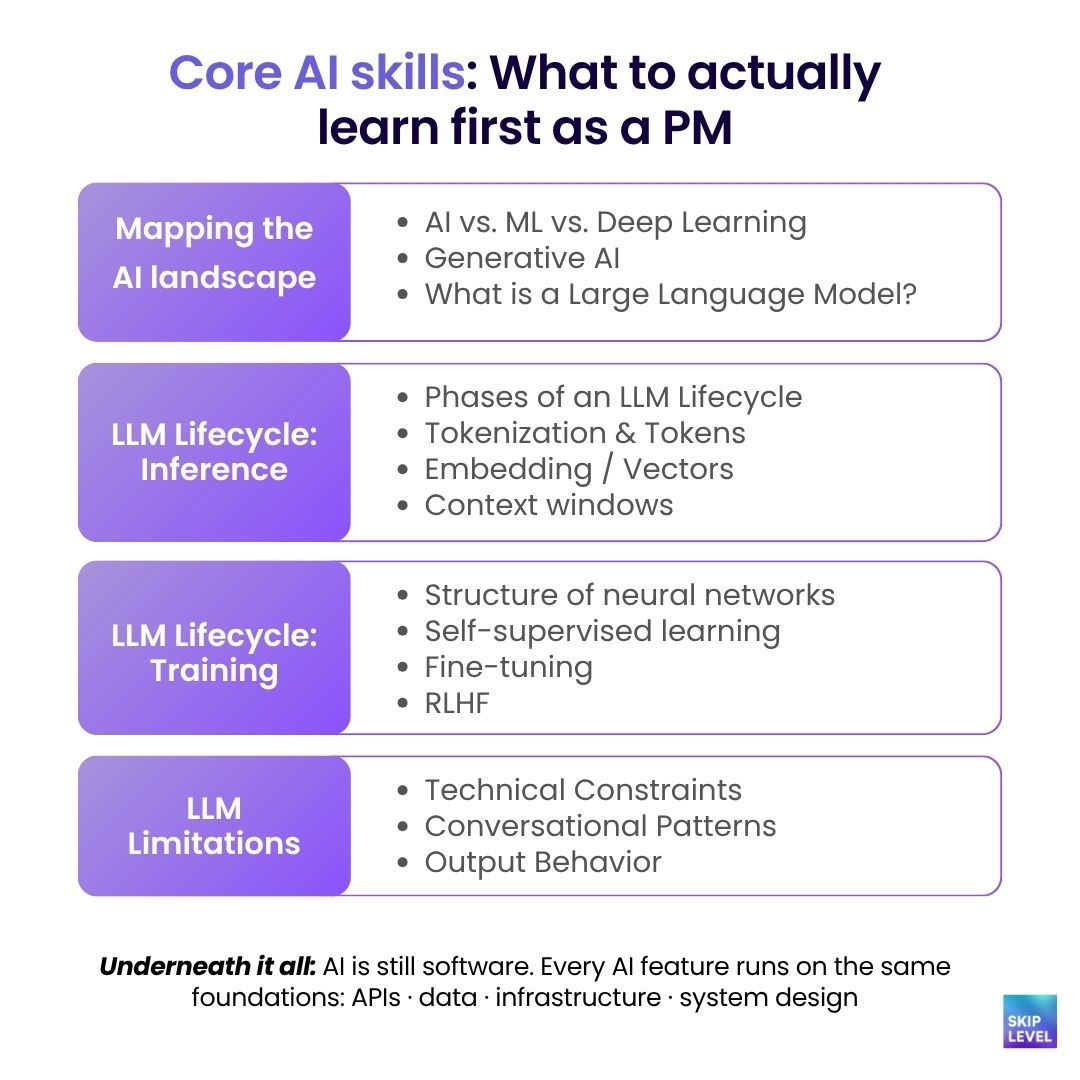
These items haven't changed since ChatGPT launched in 2022. Every new model release, every new tool, every technique sits on top of these same mechanics… even the buzzwords filling your feed right now like RAG, MCP, are just a layer on top of LLM’s core mechanics.
Ultimately what you should actually be trying to master is developing AI literacy. AI literacy means knowing what's available and possible with LLM-based AI tools, what their limitations are, and ways to work within (or around) those limitations. And developing AI literacy starts with really understanding LLMs.
Here’s an example:
Imagine leadership says "We need to synthesize thousands of pieces of customer feedback a month. What are possible AI solutions?”.
As a technically & AI literate PM, you’d be able to think through the problem:
1. What the available solutions are
With your knowledge of what’s available for building in AI, you might choose between:
Setting up an agentic workflow using n8n or Zapier for tagging feedback and a weekly agent for summarizing
Skip the pipeline entirely to export the feedback manually and work it into long-context chat LLMs (claude, NotebookLM) for clustering.
2. What the limits are
With an understanding of LLMs and their limitations, you know the agent will sometimes tag the same feedback differently on different runs, which means your week-over-week theme rends drift with the model’s variance, not your customer’s moods. LLMs are also prediction machines, so if leadership asks “what percent mention pricing?”, an LLM will give you a confident number that it generated, not actually computed.
Long-context LLM chats also have it’s own catch: each feedback that fits the window degrades in a long session. This has to do with how context windows work in LLMs. The model doesn't remember your feedback the way you'd remember a correction. Since LLMs do not have memory, it re-reads the entire conversation every single time you enter a prompt and weighs each part against everything else. The more there is to weigh, the less any one instruction counts.
3. What to do about them
You can design around LLM’s limitations by limiting how much it predicts. This means giving the agent a fixed tag list instead of letting it invent themes so you get consistency. Require verbatim quotes with source IDs for every theme (extraction instead of generation). And LLMs are notoriously bad at math so you design traditional software to do counting. The LLM tags → the spreadsheet computes.
Which option is right? That depends on your team, your risk tolerance, and the volume of feedback.
But nothing in that evaluation was a tooling question per se. The tools in both options will be different a year from now but the reasoning won't. That's AI literacy, and understanding LLMs is half of AI literacy. The other half is understanding the software systems LLMs live inside because every AI feature your team will ever ship is still built on APIs, data, and infrastructure. An agent is an LLM plus API calls plus data pipelines. A RAG system is an LLM plus a database plus retrieval logic.
AI is still software. Which means the technical foundations you build as a PM don't just survive the AI era but they're what make you fluent in it!
AI models change every month. This doesn't.